Words that will make (or cost) you money

Communication around your finances is crucial if you want to be more mindful and intentional around wealth creation.

There are some conversations that will help you ascribe meaning to your money, and these should happen early on in your planning process (and regularly thereafter). Then there are conversations that will facilitate the actioning of your financial plan and will be important when you need to make changes to your portfolio.

Here is a quick guide to five key terms that you’ll hear crop up again and again as you take action in your financial plan.

1. Dividend
A dividend is a portion of a company’s earnings that are distributed to shareholders. The dividends can take various forms but is most commonly a distribution in cash or as a portion of a share of the company. Furthermore, companies have their own policies as to when and how much of earnings are distributed in the form of dividends.

2. Bonds
There are many types of bonds, but in simple terms, a bond is a way of borrowing a sum of money – to be repaid by a fixed date in the future, with interest in the meantime. The buyers of bonds are essentially lenders, which means that if you buy a government savings bond, you become a lender to the local government.

The interest rate received is often referred to as the bond’s yield, and is the compensation that the investor receives for ‘lending’ their hard-earned money. According to an article published by Investopedia, “bonds are often referred to as fixed-income securities because the borrower can anticipate the exact amount of cash they will have received if a bond is held until maturity.“

3. Annuity
An annuity is a type of investment account that uses lump savings to generate a regular income stream – typically these are used for retirement planning.

There are two types of annuities – fixed and variable.

The key feature of a fixed annuity is that you enter into a contract with an insurer who subsequently guarantees a set income for life. This income is dependent on a number of factors such as your age, gender or whether the payment will be level or increasing. The annuity payment is guaranteed by the insurance company, so it is a good option for those who are risk averse (don’t like risk).

With a variable annuity, the risk of the investment is transferred to the annuitant in that her capital (saved money) and subsequent annuity is dependent on market performance.

4. Unit Trusts (also known as Mutual Funds in the US and UK)
According to an article published by The Balance, a “mutual fund (unit trust) is a pooled portfolio. Investors buy shares or units in a trust and the money is invested by a professional portfolio manager” who invests the capital in an attempt to produce an income and capital gains (profit) for the investors. The pool of funds is collected from many investors who wish to invest in stocks, bonds and similar assets.

One of the main advantages of unit trusts are that they offer investment vehicles where smaller investors have access to diversified, professionally managed portfolios in which each shareholder participates (wins or loses) proportionally in the gain or loss of the fund.

5. Asset Allocation
In order to invest your money, you essentially need to give it to someone who will in theory use it to make a profit by working with your assets (invested money), and you then enjoy the profits from that. If they make a loss, you make a loss too. That’s the risk you take.

Asset allocation is therefore the process of deciding how much money, based on your appetite for risk and objectives, is invested in the different available asset classes – such as equities (stocks), real estate (land and property) or commodities (eg. gold and silver).

Being able to talk about your money and how you are working with it is a powerful step in gaining confidence and power over your money, rather than allowing it to have power over you. The more we can learn together, the more we can build the lives that we want and enjoy what we have!


Hold onto your life cover

Sometimes it feels like this conversation is a broken record, constantly going round and around on the same track: people the world over are feeling the financial pinch and tightening belts.

It’s not just a local issue, and it’s not a new concern.

A few minutes on Instagram or Twitter will reveal just how many are building their third, fourth or fifth ‘side hustle’. This is partly because our internet age has made alternative streams of income more viable, but also because our current economic pressures make it almost impossible for families to cope with a single, or even dual, income.

When external pressures leave us feeling hard-pressed, it may be tempting during such times to reduce or release our risk cover policies – with life cover being a common policy to cancel. Sometimes, these decisions are made in order to maintain a certain living standard – however, this could have dire financial consequences for your loved ones.

Life cover is never an easy conversation to have. And when things are tight, you have to weigh up paying your monthly premiums against the potential effect on your family if they were to lose your income entirely in the event of a disaster.

The problem with cancelling your life cover isn’t just that it is a massive risk, but that it also may be impossible to replace it as you grow older.

Many people may assume that you can simply cancel your life assurance then reinstate it when it’s easier to afford. However, premiums are likely to be substantially higher when you’re older (cover is said to cost double at the age of 45 what it costs at age 25). Health conditions may also be excluded from the cover and, in the worst case, you may even be uninsurable if you are diagnosed with certain illnesses.

Even missing the payment of a few premiums can have a negative effect. Not only may you need to undergo the underwriting procedure again, but any deterioration in your health would be taken into account when considering policy reinstatement and premiums.

So what are the alternatives?

4 possible alternatives to cancelling life cover (this is not financial advice)

1. Reduce your monthly expenses
Cut back on items that aren’t essential, such as your television subscription. Critically evaluate your budget and examine what is imperative versus what you just would like. Remember, this is not forever, it’s about prioritizing your financial security.

2. Re-negotiate your debts
Try approaching creditors or your bank to negotiate terms of any repayments. They may be willing to accept smaller sums over a longer period.

3. Press pause on your savings
Consider taking a ‘payment holiday’ on your contributions to an investment portfolio.

4. Negotiate your premium payment pattern
Request to change to an escalating-premium pattern for your life cover, which means that your initial premiums will be lower and increase over time.

Please note that the above four points are suggested options, if you would like to review your plan inside of your changing situation – please arrange a meeting for us to objectively make the best decisions according to your individual needs. It is important to stay educated about life cover and informed about affordable solutions, so please discuss this if it is a concern.

Finding the fungibility in commodities

Depending on your level of investing savvy, you may or may not be comfortable with the term ‘commodities’. As our global systems currently enter one of the toughest times experienced in over a hundred years, you may hear this term bandied about a fair amount.

Essentially, commodities are the basic building blocks of the global economy, upon which most other goods are created. They fall into two broad categories – hard and soft.

Hard commodities are natural resources that must be mined or extracted. These include energies such as oil and natural gas, and metals such as gold and aluminium. Soft commodities, on the other hand, are agricultural products such as crops and livestock.

When it comes to investment strategies, commodities and stocks often move in opposite directions to one another. Hence, commodities can offer a good opportunity to diversify an investment portfolio — either for the long-term, or during unusually volatile periods.

Commodities are essentially uniform across producers, and this uniformity is referred to as ‘fungibility’. For example, oil would be considered a commodity, but Old Khaki’s jeans would not be, as consumers would consider them to be different from jeans sold by other stores. When traded on an exchange, a commodity must meet specific standards, which is known as a basis grade.

A commodity market is a virtual or physical marketplace that is dedicated to the buying, selling and trading of raw or primary products. There are currently about 50 major commodity markets in the world that facilitate trade in approximately 100 primary commodities.

Over the past few years, the definition of ‘commodities’ has expanded to also include financial products such as foreign currencies, indexes and exchange-traded funds (ETFs). Technological advances have also led to new types of commodities, such as mobile phone minutes and bandwidth, being exchanged.

Commodities can have a big effect on investment portfolios. Basic economic principles of supply and demand tend to drive commodities markets, so lower supply increases demand, which equals higher prices (and vice versa). For example, a major disruption, such as a health scare among cattle, might lead to a spike in the generally stable demand for livestock.

Slumping commodity prices can also provide opportunities for investors. However, investing in commodities can easily become risky because they can be affected by eventualities that are difficult to predict, such as weather patterns, epidemics, natural disasters, and even politics. As a result, it is important to carefully consider your risk appetite and the length of time you have until you wish to achieve your goals, as this will affect the recommended allocation of your portfolio to commodities.

As with all elements of your portfolio, it is important to ensure you have a solid understanding of what you have allocated and why. Don’t be afraid to ask questions if you’re ever unsure of any terminology.

Working with different money personalities

As the 2020 global pandemic for COVID-19 becomes forever etched in our history, most of us will remember how the term ‘lockdown’ moved from a novelty to a serious psychological threat. At the point of writing this blog, it’s not clear just how vast and integrated the knock-on effect of lockdown will be, but for most of us it’s confronted us with conversations we’ve never had to have before.

Being confined indoors, or a specific area for an extended period of time brings out the deeper facets of our personalities and stress coping skills. Several years ago an article by Maya on Money spoke to money personalities – and whilst this has perhaps been overlooked or avoided by many, lockdown will most certainly be a catalyst for addressing it now!

Money has been cited as the biggest reason for divorce, and differing attitudes towards money in any relationship can cause friction. So let’s take a look at some basic ‘money personalities’ and you can decide with which you most identify.

This may not only help you manage your relationships in both trying or triumphant times, but also how to go about managing your wealth creation as a couple, family or shared living arrangement.

1. The Spendthrift
A spendthrift tends to be extravagant and spontaneous with regards to money matters. However, sometimes they can be irresponsible and need protection from making financial mistakes and getting into debt that they can’t afford.

2. The Saver
Someone who saves may have quite modest tastes and needs, and long-term they may well reap the rewards of their cautious approach. However, their financial prudence and love for budgeting could be a turn-off for someone who is not that way inclined.

3. The Cinderella
Maya Fisher-French refers to the ‘Cinderella Complex’ in her article when she considers a woman’s unconscious (or conscious) desire to be cared for. Some people are simply looking for a partner who can spoil them, which Fisher-French refers to as a Blesser.

4. The Financially Independent
Other people make it their main focus to become financially independent so that they can manage their money and responsibilities on their own. They pride themselves on working hard to become financially organised and not needing to rely on anyone else. This type of person may fret about being pulled down by someone who is less financially astute.

5. The Power Hungry
Power plays can arise if someone uses money to wield power over others. The adage, “he who holds the gold, makes the rules,” may be true in some relationships – especially if there is a big difference in earnings. Money can create a shift in power that can be easily abused if all parties are not careful.

Rules should be agreed on by all who rely on each other. Different money personalities can be compatible if a balance is achieved; everyone needs to recognise the strengths they are bringing to the relationship.

For example, a Saver can help a Spendthrift to avoid some financial miscalculations, while a Spendthrift can teach a Saver to loosen up and enjoy splashing a bit of cash sometimes.

Likewise, someone who enjoys spending money on their family could be compatible with those who enjoy having money spent on them.

If there has been a major change (loss of income or work for any of the income earners in the home) it can be enormously stressful if we don’t have the words and tools to have better conversations about earning, saving and spending the household money.

It’s powerful to know what type of money personality you are and to find synergy in your relationships. It’s not necessarily a question of having the same attitude and approach to money issues, but rather finding compatibility and compromise.

Investing amid uncertainty

Anything of any value takes time. Likewise, creating wealth is a long-term process.

Well-structured investment strategies have always taken uncertainty into account. Patience, resilience and a robust strategy are imperative to weather the global investment storm that has been raging in recent times.

As you embark, or continue, upon your journey to great financial security, it is important to wholly understand the investment landscape. This is one of the areas where having an adviser you trust will help you successfully navigate the ups and downs of a stormy market and exploit the nuances of profit-yielding opportunities.

If you experience pangs of fear or doubt along your journey, then it means that you’re taking it seriously and you’re engaging in what’s going on around you. No-one is immune to these experiences.

What exactly has created the stormy conditions?
Recent market events are focussed almost entirely on the effects of the global lockdowns relating to COVID-19, but in the months leading up to 2020, we’ve been seeing volatility in the markets. Some of these relate to oil prices, trade wars between China and USA as well as credit ratings from the big three credit rating agencies — Fitch Ratings, Moody’s and Standard & Poor’s (S&P).

Add in the winds of political uncertainty and the high pressure systems of a fast changing global economy, many investors have at best been treading water or have seen their wealth decline in real terms, as portfolios have largely been unable to beat inflation over the short term.

Goodbye to the Past
It is important to put things into perspective and appreciate that investment markets often go through weaker growth periods of consolidation (this is technically known as a process of reversion to the mean).

Given the current global climate, 2020 and possibly 2021 are likely to be a time of consolidation in the markets. However, if you’re looking to achieve a long-term investment goal, it is important to not be swayed by short-term ideals or emotions, as you have a higher probability of growing your wealth if you stick to your investment strategy.

The Five Steps to Long-term Investment Success and Financial Independence

  1. Determine your investment objective by specifying a realistic goal you wish to achieve.
  2. Set your time horizon, which is the number of years you have to achieve your goal.
  3. Decide on an appropriate investment strategy by selecting a combination of asset classes in which to invest – bonds, property, cash, offshore assets, and equities.
  4. Select the most appropriate investment platforms, products and asset managers through which your chosen investments can be made.
  5. Monitor and review all of the above on an ongoing basis.

While a great deal of uncertainty remains for all investors, it is important to understand that uncertainty, and even volatility, in investment markets do not only represent risk, they also represent opportunities. Uncertainty is not new, either. It’s easy to blame current conditions, but if your strategy is prepared for uncertainty, if you are in the right headspace, you will be able to remain prudently invested in the markets.

It’s important to remain informed and seek to improve your knowledge about your investments, then keep the various elements of your investment plan aligned to navigate uncertain waters and continue on your journey to wealth creation.

A level head saves skewed vision

As Nelson Mandela said, once we’ve climbed a great hill we only find that there are many more hills to climb. When you’re looking up or down the hill, it’s easy to have a skewed vision of what’s really going on. We spend more time going up and down than resting at the top; it’s difficult to hold a level head in times of turmoil.

You may look at your bank statement this morning and see that there won’t be enough to cover your debit orders and upcoming expenses. This is scary! Conversely, you may see plenty of money and fear wasting it!

Money will always flow in and out; the longer we live and earn, the more we are reminded of this.

Whether your financial resources are lean or lush, you may be tempted to make some big moves to manage the coming months as wisely as you can.

When it comes to managing your investments it’s crucial to stay focused on the bigger picture – even when recent events may have you itching to move your investments out of the market and into cash. We need to keep a level head and not skew our vision.

The herd mentality, or groupthink, to ‘cash in’ arises from the fact that cash investments are readily available for use and are mostly free of investment risk. The low risk of a bank failing is essentially the only concern as they are investments on short-term, variable-rate deposits with reputable banks.

However, in an article published at the start of April 2017 in Personal Finance, Leigh Kohler, the head of research at Glacier by Sanlam (South Africa), explained that it’s important in uncertain times to remember that even though a cash investments may seem like a comparably safe option, the returns don’t often beat inflation. According to her, only once between 2001 and 2016, did cash investments outperform local equities and bonds.

Furthermore, if you had been invested only in South African equities over this period, you would have received an average return of 17.12%, compared to just 7.96% if you had only invested in local cash investments.

You are also taking two market-timing risks if you wish to move your investments into cash then back again once things have calmed down, and research shows that getting the timing wrong can be a devastating blow to your portfolio.

What should you do in lieu of making an emotional decision?

  • Slow down your decision making process and include your trusted adviser;
  • Invest in a combination of asset classes in line with your needs, time horizon, and risk tolerance;
  • Invest in a suitable multi-asset fund;
  • Ensure you have sufficient exposure to offshore assets;
  • Understand and believe in your long-term investment strategy, then stick to it.

Scary times come and go – the burden of responsibility weighs on us regardless. How we protect and use our hard earned wealth and accumulated assets need to reflect what’s truly important to us, and not be a reaction to current trends and happenings.

Avoid these investment decisions

Do you know what’s going to happen in the markets tomorrow?

Neither do we!

All we know is that the markets are an opportunity to invest our money in helping the economy grow, and watching our money grow with it. That’s a really simplistic view, but it helps us extract our emotional reactions from the final decisions that we make.

Should we ignore fear? Absolutely not – we should talk about it lots! That’s one of the benefits of having a financial adviser that you trust on your side. Talking things through is a great way to avoid knee-jerk reactions.

Having recently researched some articles on Investopedia and USnews – here are some emotional reactions to avoid.

1. Avoid isolating your decisions
Rather examine the potential impact that each decision could have on an entire portfolio. This applies to selling AND buying. Failure to do this can result in you investing too much in a single asset class, industry, or geographic market. It could also result in your selling off when the market is at its lowest. Remember to step back, look at the bigger picture and then make your decision.

2. Avoid looking at the immediate conditions
Don’t just ignore the potential of long-term wealth accumulation in favour of short-term losses or returns. Statistically, losses happen more frequently over a short timeframe and, as people tend to be very sensitive to losses, a behavioural phenomenon known as ‘myopic loss aversion’ occurs, which affects willingness to take short-term risks. This, in turn, results in people making emotion-based investment decisions that can have a negative effect on a portfolio.

3. Avoid blindly following the crowd
A good investment strategy is to buy low and sell high, but if you follow the masses blindly, it’s easy to end up buying high and selling low, which may have opposite results and prevent you from taking advantage of the same market opportunities. A buy-and-hold strategy is often far superior.

If you know that you can be prone to having knee-jerk reactions, you may wish to try to avoid constant information about how the market or your portfolio is performing, so that you can just focus on sticking to your long-term investment strategy. Don’t chase the news or get swept away by fear and groupthink.

4. Avoid frequent trading
Again, if you are prone to having a sometimes irrational bias towards action you need to slow things down. Moving too quickly can result in higher investment costs and an increase in making poor decisions.

If you ever have itchy feet, it can often be a good idea to wait a few days before executing a big financial decision and seek advice by organising a meeting to discuss an option.

5. Avoid investing money that you cannot afford to lose
It’s important to keep cash on the side for emergencies and opportunities. You may not feel happy having some of your money just sitting there, not earning boastful returns, but having all your money tied up in the market is a risk that’s arguably not worth taking.

To help you make healthy financial decisions, set yourself some rules, such as only contributing a percentage of your monthly income; and establish some realistic targets, such as aiming to save a certain amount of money by the end of the year. Some people can even find it helpful to limit their options by purchasing more illiquid investments to avoid the urge to simply sell or switch on a whim or when the markets aren’t performing as desired.

Many people also find delegation a handy tool. By delegating your financial decisions to a professional who you trust to manage your portfolio, you can spare yourself a lot of stress and rest assured that you will receive sound advice as to how best to execute your financial plan to achieve your goals.

Bear Markets vs Bull Markets

When it comes to investing in the markets, the terms bull and bear market are used to describe how stock markets are doing in general.

Simply put, are they going up or are they going down?

At the same time, because the market is determined by investors’ attitudes, these terms also denote how investors feel about the market and the ensuing trends.

Driving up
A bull market refers to a market that is on the rise. It is typified by a sustained increase in price, for example in equity markets in the prices of companies’ shares. In such times, investors often have faith that the uptrend will continue over the long term.

Typically, in this scenario, the country’s economy is strong and employment levels are high.

Dipping down
By contrast, a bear market is one that is in decline, typically having fallen 20% or more from recent highs. Share prices are continuously dropping, resulting in a downward trend that investors believe will continue, which, in turn, perpetuates the downward spiral.

During a bear market, the economy will typically slow down and unemployment will rise as companies begin laying off workers.

How does this affect investor behaviour?
Because the market performance is impacted and determined by how individuals perceive that performance, investor psychology and sentiment affect whether the market will rise or fall. Stock market performance and investor psychology are mutually dependent. In a bull market, investors willingly participate in the hope of obtaining a profit.

During a bear market, market sentiment is negative as investors are beginning to move their money out of equities and into fixed-income securities, as they wait for a positive move in the stock market. This is not always the best move – following the crowd is not always in our best interest.

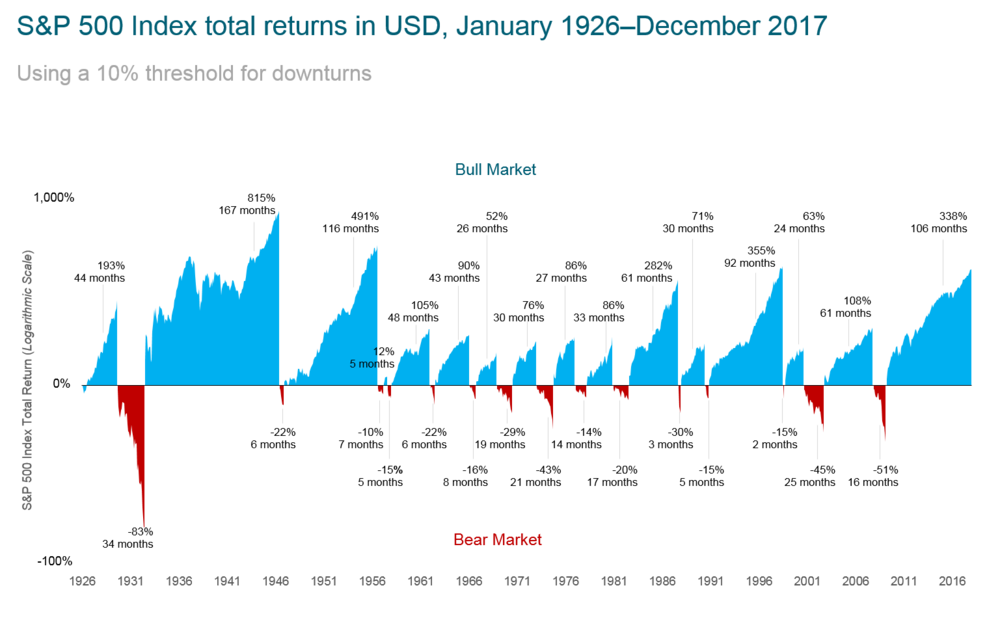
For those who are able to ride the market out, in theory, will benefit in the long run. The graph above shows us that in the last 90 years, the markets have grown more than they have fallen.

How does this affect the economy?
Because the businesses whose stocks are trading on the exchanges are participants in the greater economy, the stock market and the economy are strongly linked.

A bear market is associated with a weak economy as most businesses are unable to record huge profits because consumers are not spending nearly enough. This decline in profits, of course, directly affects the way the market values stocks.

In a bull market, the reverse occurs, as people have more money to spend and are willing to spend it, which, in turn, drives and strengthens the economy.

The Bottom Line
Both bear and bull markets will have a large influence on your investments, so it’s a good idea to take some time to determine what the market is doing when making an investment decision. Having the input from your financial adviser is crucial at this point – but neither market situation is better or worse than the other as both have opportunities and threats to your investment potential.

Remember that over the long term, the stock market has always posted a positive return.

Click here for the article on Investopedia

Why have the markets taken a knock?

In a nutshell, the markets are driven by business activity which is supported by investor confidence. When businesses have investors, they can grow and create more value, which in turn encourages more investors. When businesses can’t run normally (like in the case of a global pandemic), investors fear they will lose money and pull out their investments or stop supplying more cash – which hits the businesses even harder.

The interconnected world we live in means we are all affected by movements in other countries. Trade shutdowns and lockdowns on the other side of the world will affect everyone here too.

Whether it’s directly linked to investments, supply of goods to trade, or indirectly through the price of petrol for our cars or the supply and cost of goods in the grocery stores. Some of us will be fortunate not to lose our jobs, but our economy will shoulder the burden of those who do.

Events that knock global markets are often referred to as Black Swan events.

The Black Swan theory describes an event that is unpredictable and which has a significant impact. For example, if we take the effects of COVID-19 (Coronavirus) and add it to an oil war, spice it up with local business confidence being low we have a significant knock to our economy.

The good news is that we’re all in this together. We’re not isolated, which means that we can work together with greater strength and resolve to solve the problems that will stem from a global Black Swan event. We see this in how banks and other large companies step in to assist consumers.

“Recently, the coronavirus pandemic has added uncertainty to global markets. No one can confidently state its impact or for how long it will last. It has already impacted our tourism sector, slowed down economic activity and caused growth forecasts to be slashed. This has led to a large sell-off of riskier emerging market assets reflected in the over 25% drop in the JSE Top 40 index within the last month. The latest global travel bans and the drop in the S&P 500 by over 20% are indicators of the virus’s effect on first-world countries.” 22Seven

When we see words like “economic crash” filling up our Twitter feed, we may rightly begin to worry about our investments.

We have two options: sell now and time our re-entry or wait it out.

The market does recover – this has been proven time and time again over the last 90 years. As it stands, recovery times are, on average, just under two years when in a bear market (watch out for a blog coming soon on bull vs bear markets!).

However, it’s difficult to predict share price movements. This is another reason to not sell investments, as it’s difficult to predict when to buy them back. A good strategy for most would be to continue with monthly capital injections.

(Ideas for this blog come from 22seven)

Don’t sabotage your future self

Bad market performance, government lockdowns, global epidemics and loadshedding aren’t what threaten our investing and financial behaviour.

Our biggest threat is ourselves.

Studies have shown that people improve substantially in financial and investment decisions as they get older. When we are young — and perhaps less secure in our financial situation — we have a tendency to be controlled by emotional biases; strong impulses that can be detrimental to our investment habits.

Behavioural economists refer to some typical flaws that are commonly seen in investment decisions as failures of rationality. In order to achieve long-term financial goals, it is, therefore, important to identify and wrestle with some of our personality-driven investing mistakes.

Even more so when we’re going through a crisis and it’s confrontational!

It’s hard, but it’s not impossible.

The first step is to accept that a problem exists in the way that we approach our decision making – before we sabotage ourselves. It is then a question of devising a set of strategies to control, or at least mitigate, harmful decisions.

It’s important to be kind to yourself at this point – sabotaging your future self DOES NOT mean overextending yourself now to keep up with premiums, but it also means not selling off investments out of fear if it’s not in your best interest. The goal is to slow your decision process down so you avoid making errors you will regret.

According to a survey conducted by Barclays Wealth, many wealthy investors realise their tendency to make emotional decisions, and would be happy to have some help dealing with certain issues.

The ability to exercise control plays a vital part in financial decision-making, especially when investment climates can be volatile, confusing, and nerve-wracking. It is important to feel confident in your financial plan, so that you can resolutely commit to whatever investment strategy you decide will benefit your future self best.

For example, research suggests that there is a psychological phenomenon referred to as the trading paradox. A high percentage of investors feel they need to trade frequently in order to maximise their investment gains but, at the same time, many of the same investors feel that their overall returns suffer because they trade too much. Even though certain investors have this realisation and see the downfalls of their actions, they still give in to emotionally-triggered temptations and often miss out on optimal returns as a result.

Behavioural coaching, in this instance, could help someone to focus on methods of changing this behaviour for good.

Behavioural Coaching

Behavioural coaching employs a range of professional techniques to help you to make changes to certain patterns of behaviour. Behaviour comprises actions and reactions, and behavioural coaching has been defined by the Behavioural Coaching Institute as “the art of facilitating the learning and development of an individual, so as to increase their effectiveness and happiness”.

It emphasises that much of human behaviour is, in fact, learned, and that all behaviours result in positive or negative consequences for the individual and those around them.

This model of coaching, therefore, involves identifying and measuring certain learned behaviours and their impacts. To do this requires an exploration of core values and motivations, as well as assessing covert behaviours (such as anxiety or self-defeating beliefs) in relation to overt actions (such as public speaking).

Once you have identified an issue and sought professional guidance in establishing a personal set of effective coping mechanisms, it is important to consistently exercise your newfound good habits. These need to be practiced on an ongoing basis, and regular monitoring and evaluation will help you to achieve long-term success.